
Ball Position Irons: Where to Play Every Iron for Better Contact

Quick Answer
For most standard iron shots, start with the ball near the center of your stance and move it gradually forward as the club gets longer. Your goal is ball-first contact with the swing reaching its low point after impact, a fundamental also emphasized in PGA iron-contact instruction.
Quick iron ball-position setup
- Short irons: Start around the middle of your stance or slightly forward of center.
- Mid-irons: Move the ball roughly one ball-width forward of center.
- Long irons: Start about one to two ball-widths farther forward while staying inside the lead heel.
- Check the strike: Your divot should normally begin after the ball on a clean turf shot.
- Adjust carefully: Move the ball in small increments instead of making large setup changes.
The key
- Use these positions as starting points, then match them to your swing’s natural low point and strike pattern.
If you searched for “ball position irons,” you’re probably trying to stop hitting shots fat, thin, or unpredictably. Ball position looks like a small setup detail, but it can change where your club reaches the ground.
I like to treat ball position as a repeatable reference instead of chasing a perfect measurement. Once the setup stays consistent, diagnosing the rest of the iron swing becomes much easier.
In This Guide
- What Is the Correct Ball Position for Irons?
- Where Should You Play Short, Mid, and Long Irons?
- Why Does Iron Ball Position Change?
- What Happens When the Ball Is Too Far Forward or Back?
- How Should Ball Position Change for Different Iron Shots?
- How Can You Practice Consistent Iron Ball Position?
- Frequently Asked Questions
What Is the Correct Ball Position for Irons?
The correct iron ball position places the ball slightly before the low point of your swing. That lets the club contact the ball while traveling downward, then reach the turf after impact.
Definition: Ball position is the location of the golf ball relative to your feet and body at address. For irons, it helps determine where the club meets the ball in relation to the bottom of the swing arc.
A common mistake is assuming every golfer needs an identical measurement. Stance width, body proportions, club length, swing pattern, and shot choice all influence how a position looks.
That’s why I prefer a simple reference system. Start near center with short irons, then let the ball appear progressively farther forward as the clubs get longer.
- Lead side: The side closest to the target.
- Trail side: The side farthest from the target.
- Forward of center: Slightly toward the lead foot from the midpoint of your stance.
- Low point: The lowest part of the clubhead’s swing arc.
- Angle of attack: Whether the clubhead moves downward or upward as it reaches the ball.
The ball should not normally sit as far forward as a driver when you hit a standard iron from turf. It also does not need to sit dramatically behind center just because you want to hit down.
Moving it too far back can create its own problems. You may reduce effective loft, steepen the strike, or start the ball lower than intended.
Some respected instructors prefer keeping the ball in nearly the same location while changing stance width. Sean Foley has explained this constant ball-position approach, which shows there is more than one workable system.
Section Takeaway: Use ball position to support ball-first contact, not as an isolated rule. A repeatable reference matters more than chasing one universal measurement.
Where Should You Play Short, Mid, and Long Irons?
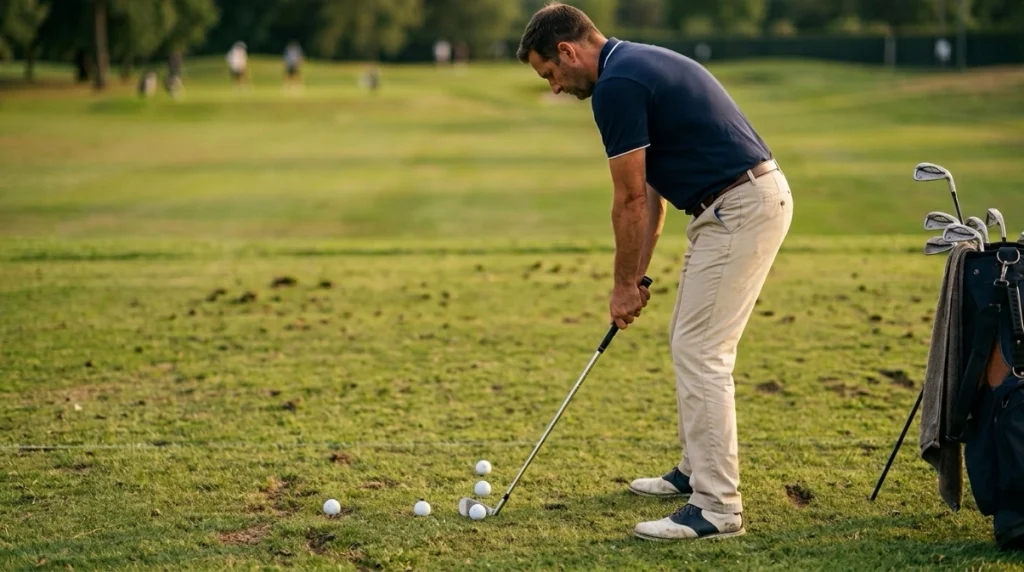
For a practical starting point, position shorter irons close to center and gradually move longer irons toward the lead foot. The changes should be small.
| Iron Category | Practical Starting Position | Typical Contact Goal | Common Error |
|---|---|---|---|
| 9-iron / pitching wedge | Center to about one ball-width forward | Ball first, turf second | Playing it too far back |
| 7-iron / 8-iron | About one ball-width forward of center | Descending strike with predictable launch | Letting position drift between shots |
| 5-iron / 6-iron | Roughly one to two ball-widths forward of center | Shallower downward strike | Moving it toward the lead heel too aggressively |
| 3-iron / 4-iron | Forward of center but still inside the lead heel | Clean contact near the bottom of the arc | Treating the iron like a driver |
These are starting references rather than mandatory positions. Your strike pattern should decide whether a small adjustment is needed.
Short irons have shorter shafts and more loft, so a centered setup usually supports the steeper strike golfers expect from them. Longer irons use longer shafts and less loft, which often feels more comfortable with the ball slightly farther forward.
I use a 7-iron as the reference club when checking my own setup. It is long enough to expose poor positioning but short enough to make strike feedback easy to read.
- Start with the 7-iron: Set the ball slightly forward of stance center.
- Move to a 9-iron: Narrow the stance and let the ball appear closer to center.
- Move to a 5-iron: Widen the stance slightly and place the ball a little farther forward.
- Compare the strike: Look for consistent ball-first contact rather than identical divot sizes.
Butch Harmon also emphasizes the relationship between stance and ball position when teaching crisp iron contact. His iron-impact guidance warns against placing the ball excessively forward or back.
Section Takeaway: Think in small progressions from short iron to long iron. The ball should not jump several inches forward every time you change clubs.
Why Does Iron Ball Position Change?
Ball position changes because club length, stance width, swing geometry, and intended contact change across an iron set. Longer clubs normally produce a wider and somewhat shallower motion.
The important concept is the swing arc. The clubhead travels downward, reaches its lowest point, then begins moving upward.
- Ball before low point: Supports the downward strike used for normal iron shots.
- Ball at the wrong point: Can make clean contact harder even when the swing feels normal.
- Longer club: Usually encourages a wider arc and slightly more forward setup.
- Shorter club: Usually works with a narrower stance and more centered appearance.
Loft also matters. A 9-iron already has enough loft to launch the ball without helping it upward.
That is why trying to scoop a short iron often produces thin contact. The club’s loft should launch the shot while your strike stays committed through the ball.
Long irons need enough effective loft and speed to launch properly. Playing them excessively back can deloft the club and make the shot unnecessarily difficult.
There are two useful setup philosophies, and both can work:
- Progressive positioning: The ball moves gradually forward as the club gets longer.
- Constant reference positioning: The ball remains near one lead-side reference while stance width changes around it.
As of 2026, you will still find skilled instructors teaching both systems. Choose the method that gives you the most repeatable low point and centered contact.


What Happens When the Ball Is Too Far Forward or Back?
A ball that is too far forward can make you reach it after the club has already approached its low point. A ball that is too far back can make the strike excessively steep or alter launch and direction.
Start by reading contact rather than guessing. Your divot, turf interaction, starting direction, and strike location provide useful clues.
| Setup Problem | Possible Signs | First Adjustment |
|---|---|---|
| Too far forward | Thin shots, heavy shots, inconsistent face contact | Move the ball back about half a ball-width |
| Too far back | Low launch, steep divots, reduced loft | Move it forward about half a ball-width |
| Position changes unknowingly | Strike changes despite the same swing thought | Use an alignment reference during practice |
Ball position is not the only cause of fat or thin shots. Posture, pressure movement, early extension, balance, and clubface delivery can create similar symptoms.
That distinction matters. If moving the ball does not improve the strike after several controlled shots, stop moving it and inspect the swing instead.
I prefer half-ball-width changes during practice. Large adjustments can hide the original problem and create a second one.
How Should Ball Position Change for Different Iron Shots?
Your stock iron position is only a baseline. Uneven lies, wind, trajectory control, and specialty shots can justify small changes.
- Lower flight: Move the ball slightly back and make a controlled swing without forcing a steep chop.
- Higher flight: A slightly more forward position can help, but avoid trying to scoop the ball upward.
- Uphill lie: Expect the slope to add effective loft and influence your balance.
- Downhill lie: Match your body to the slope and expect a lower launch.
- Fairway bunker: Prioritize clean contact and avoid moving the ball so far back that the strike becomes overly steep.
- Punch shot: A modestly back position can support lower launch when combined with reduced finish and controlled speed.
Changing ball position also affects how the clubface reaches the ball. Moving it backward or forward changes the point in the swing where impact occurs.
That means direction can change too. Do not assume ball position controls height alone.
When I practice trajectory shots, I first hit three stock shots from my normal reference. Only then do I move the ball, because that makes the effect of the change easier to judge.
Avoid combining five adjustments at once. Changing ball position, grip, stance, face angle, and swing length together makes it impossible to know what helped.
How Can You Practice Consistent Iron Ball Position?
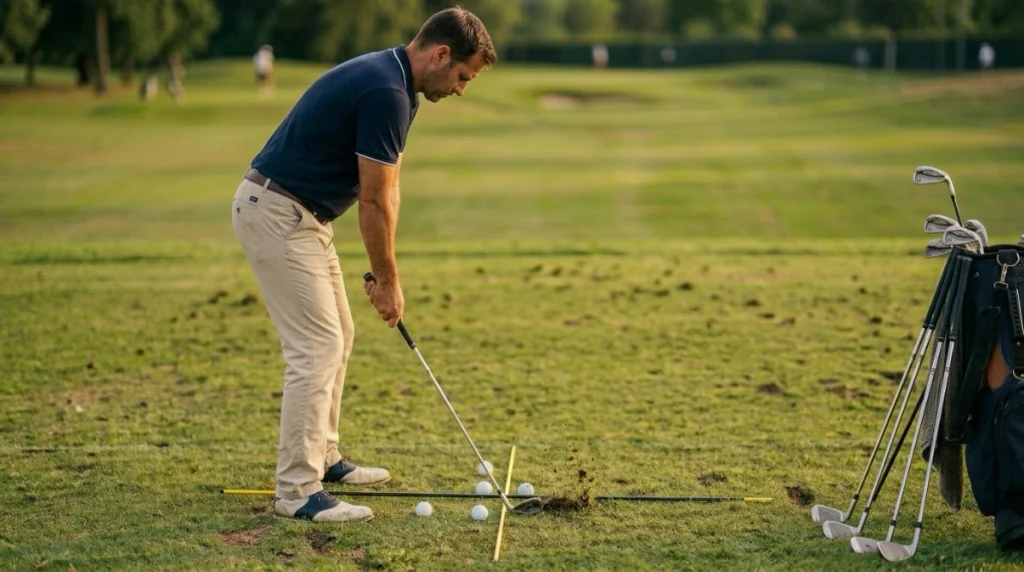
The easiest way to improve ball position is to make it visible during practice. Use simple references so your eyes learn what center and forward-of-center actually look like.
Use a perpendicular alignment reference
Place one alignment stick along your target line and another perpendicular to it during range practice. Set the ball beside the second stick to create a consistent reference.
Hit several shots without changing the reference. Then switch clubs and notice how stance width changes the ball’s appearance.
Rules note: Alignment rods are excellent practice tools, but do not set an object down to help take your stance during a competitive stroke. The USGA Rules clarifications explain the restriction under Rule 10.2b.
Use the three-ball progression drill
- Hit five controlled 9-irons from your normal short-iron position.
- Hit five 7-irons with the ball slightly farther forward.
- Hit five 5-irons with another small forward adjustment.
- Return to the 7-iron and rebuild the original reference.
- Judge contact before judging distance.
The final step is important. If you can return to the same 7-iron position without searching for it, the setup is becoming repeatable.
Check where the club meets the turf
On grass, inspect where the divot begins relative to the ball’s original location. For a standard iron shot, you generally want the strike before the deepest part of the turf interaction.
On mats, use impact tape, face spray, or strike-location feedback instead. Mats can hide heavy contact because the club may bounce into the ball.
Pro tip: If your low point remains inconsistent after working on setup, have a certified PGA instructor check your ball position and movement in person. You can use the PGA Coach directory to find professional instruction.
Section Takeaway: Practice one reference until it becomes automatic. Consistent setup gives you much better feedback than constantly moving the ball to rescue poor contact.
Frequently Asked Questions About Ball Position for Irons
Should the ball be in the middle of my stance for every iron?
No. Center is a useful starting point for shorter irons, but many golfers move the ball slightly forward as club length increases. Some instructors use a constant lead-side reference instead, so consistency and strike quality matter more than one universal position.
Where should the ball be for a 7-iron?
A practical starting point is slightly forward of the center of your stance, often around one ball-width. From there, check whether you are producing clean ball-first contact and adjust only in small increments.
Where should the ball be for a 5-iron?
Start roughly one to two ball-widths forward of center, depending on your stance width and swing. The ball should remain comfortably inside the lead heel rather than moving into a driver-style position.
Can ball position cause fat iron shots?
Yes, poor ball position can contribute to fat contact by putting the ball in the wrong place relative to your swing’s low point. However, pressure movement, posture, balance, and swing mechanics can cause the same problem.
Can ball position cause thin shots?
Yes. If the club reaches its lowest point too early or too late relative to the ball, you may catch the ball low on the face. Check your setup first, then investigate swing mechanics if the problem remains.
Should I move the ball back to hit down on my irons?
Not automatically. Moving the ball slightly back can change trajectory, but placing it too far back may create a steep strike and reduce effective loft. A standard iron shot should come from good low-point control rather than an exaggerated back-ball position.
Should my divot start before or after the golf ball?
For a normal iron shot from turf, the club should contact the ball before reaching the deepest part of its interaction with the ground. Seeing turf disturbance on the target side of the original ball position is a useful feedback point.
Final takeaway: Good iron ball position is simple when you build a repeatable reference. Start near center with short irons, move gradually forward with longer irons, and let strike quality tell you whether a small adjustment is needed.
Work on the setup before rebuilding your swing. When the ball starts in the same reliable place, your contact patterns become much easier to understand and improve.