
Golf for Complete Beginners: A Practical Guide to Learning the Game

Starting golf can feel more complicated than it should. There are different clubs, unfamiliar rules, swing instructions, dress codes, scoring terms, and equipment choices. Many new golfers worry about playing too slowly, buying the wrong gear, or embarrassing themselves on the course.
The good news is that you do not need an expensive set of clubs or a technically perfect swing to begin. Golf for complete beginners is mainly about learning a few fundamentals, making consistent contact, understanding basic course etiquette, and enjoying gradual improvement.
This guide explains how golf works, what equipment you actually need, how to build a simple swing, what to expect at a golf course, and how to practice without developing costly habits.
Quick Answer
Golf for complete beginners starts with learning the basic objective, using a small set of forgiving clubs, practicing short shots before full swings, and understanding simple course etiquette. Focus on solid contact rather than distance. A few lessons, regular short practice sessions, and realistic expectations will help you improve faster and enjoy the game.
How Golf Works
The objective of golf is simple: move the ball from the starting area, called the teeing area, into the hole using as few strokes as possible.
A standard golf course normally has 18 holes, although many courses also offer nine-hole rounds. Each hole has a suggested number of strokes called par.
For example:
- A par-3 hole is expected to take three strokes.
- A par-4 hole is expected to take four strokes.
- A par-5 hole is expected to take five strokes.
Your total score is the number of strokes you take. A lower score is better, but beginners should not become overly concerned with par. Your first goal is to complete each hole safely, maintain a reasonable pace, and learn from every shot.
Basic Golf Scoring Terms
| Term | Meaning |
|---|---|
| Birdie | One stroke under par |
| Par | The expected number of strokes |
| Bogey | One stroke over par |
| Double bogey | Two strokes over par |
| Triple bogey | Three strokes over par |
| Handicap | A number representing a golfer’s demonstrated playing ability |
A handicap allows players of different skill levels to compete more fairly. You do not need one for casual beginner golf. When you begin recording regular rounds, the USGA’s Handicapping 101 guide explains how a Handicap Index is established and updated. (USGA)
What Golf Equipment Does a Beginner Need?
You do not need a full premium set when learning. In fact, carrying too many clubs can make decisions more confusing.
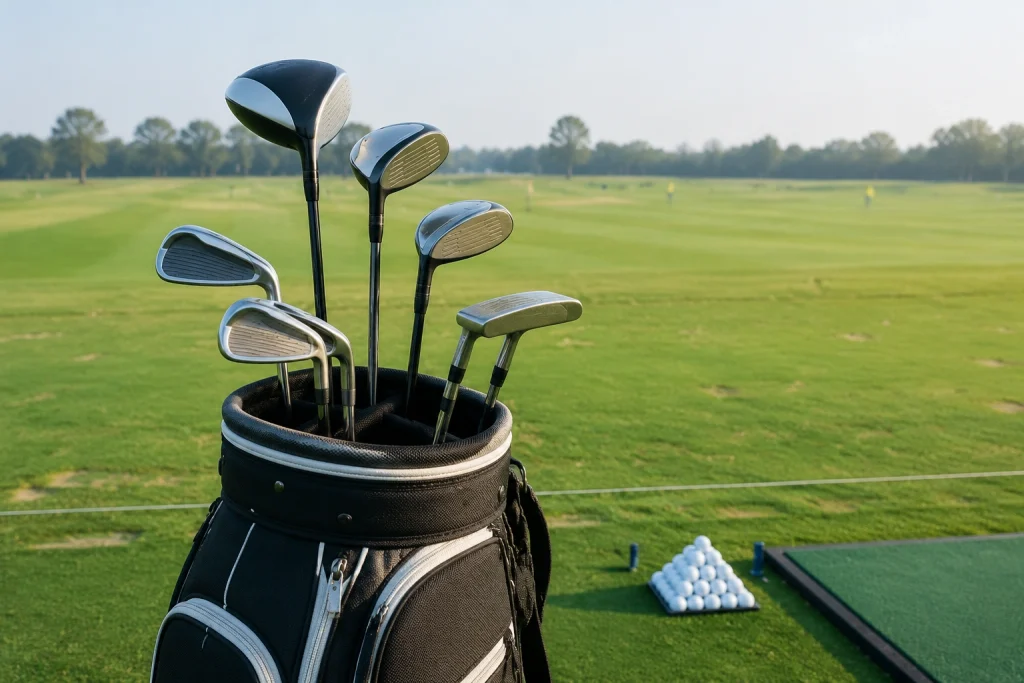
A practical beginner setup includes:
- Driver or fairway wood
- Hybrid
- 7-iron
- 9-iron
- Pitching wedge
- Sand wedge
- Putter
- Golf bag
- Golf balls
- Tees
- Golf glove
- Divot repair tool
- Ball marker
A boxed beginner set may include additional clubs, which is fine. However, the quality of your decisions and contact matters more than the number of clubs in your bag.
Beginner-Friendly Club Types
Driver
The driver is designed for long shots from the tee. It has the largest clubhead and usually the longest shaft.
Drivers can be difficult for complete beginners because the longer shaft makes the club harder to control. Practice with one, but do not feel required to use it on every hole.
Fairway Woods
Fairway woods can be used from the tee or fairway. A 5-wood or 7-wood is often easier to launch than a low-lofted long iron.
Some beginners hit a fairway wood more consistently than a driver. A slightly shorter but straighter tee shot is usually more useful than a long shot that finishes in trouble.
Hybrids
Hybrids combine characteristics of woods and irons. They are commonly used instead of difficult long irons.
A hybrid can help beginners launch the ball higher from the fairway, rough, or tee. It is one of the most versatile clubs in a beginner’s bag.
Irons
Irons are used for approach shots and controlled shots toward the green. Higher-numbered irons, such as a 7-, 8-, or 9-iron, are generally easier to learn than lower-numbered irons.
Start practicing with a 7-iron. Its moderate length and loft make it suitable for learning setup, balance, and ball contact.
Wedges
Wedges are designed for shorter shots. A pitching wedge works well for basic approach shots, while a sand wedge provides extra loft for bunkers and shots around the green.
Beginners should spend significant practice time with wedges because short-game shots have a major influence on scoring.
Putter
The putter is used on the green. Since putting requires less speed and body movement than a full swing, it is one of the easiest areas for a beginner to practice productively.

How Much Should a Beginner Spend?
Golf equipment can range from inexpensive used clubs to premium custom-built sets. A beginner should avoid making a large investment before developing a repeatable swing.
| Purchase approach | Best for | Benefits | Limitations |
|---|---|---|---|
| Borrowed or rental clubs | First practice sessions | Very low commitment | Fit and condition may be inconsistent |
| Used partial set | Budget-conscious beginners | Affordable and practical | Requires checking wear and damage |
| New boxed beginner set | Players ready to continue | Convenient matching set | Limited customization |
| Professionally fitted set | Committed players with a repeatable swing | Better length, lie, shaft, and club selection | Higher initial cost |
Spend first on clubs that are:
- The correct general length
- Comfortable to hold
- Free from cracks or major damage
- Fitted with usable grips
- Forgiving enough for inconsistent contact
Do not buy advanced “player’s” irons simply because they look attractive. Smaller clubheads and less-forgiving designs can make learning unnecessarily difficult.
Used clubs can provide excellent value, but inspect the grips, shafts, clubfaces, and connection between the shaft and clubhead. Worn grips are replaceable. Bent shafts, cracked heads, and loose components are more serious warning signs.
Learn the Basic Golf Setup
A reliable setup gives your swing a better starting point. You do not need to copy a professional golfer’s posture exactly, but you should build a balanced and repeatable position.
1. Hold the Club Securely but Lightly
Your hands connect your body to the club. A grip that is too tight creates tension in the arms and shoulders.
Hold the club firmly enough that it will not move during the swing, but not so tightly that your forearms become stiff. On a pressure scale from 1 to 10, many beginners benefit from starting around 4 or 5.
2. Stand With Balanced Posture
For a mid-iron:
- Place your feet roughly shoulder-width apart.
- Bend slightly from the hips.
- Allow your knees to flex naturally.
- Let your arms hang below your shoulders.
- Keep your weight balanced through the middle of your feet.
Avoid sitting too far back on your heels or leaning toward your toes.
3. Position the Ball Correctly
Ball position changes with the club.
- Wedges: near the center of your stance
- Mid-irons: slightly forward of center
- Hybrids and fairway woods: farther forward
- Driver: near the inside of your lead heel
For a right-handed player, the lead foot is the left foot. For a left-handed player, it is the right foot.
4. Aim the Clubface First
Many beginners aim their feet before the clubface. This can create alignment errors.
Aim the clubface toward the target first. Then position your feet, hips, and shoulders roughly parallel to the target line.
A Simple Beginner Golf Swing
The golf swing should feel like one connected motion rather than a list of separate body positions.
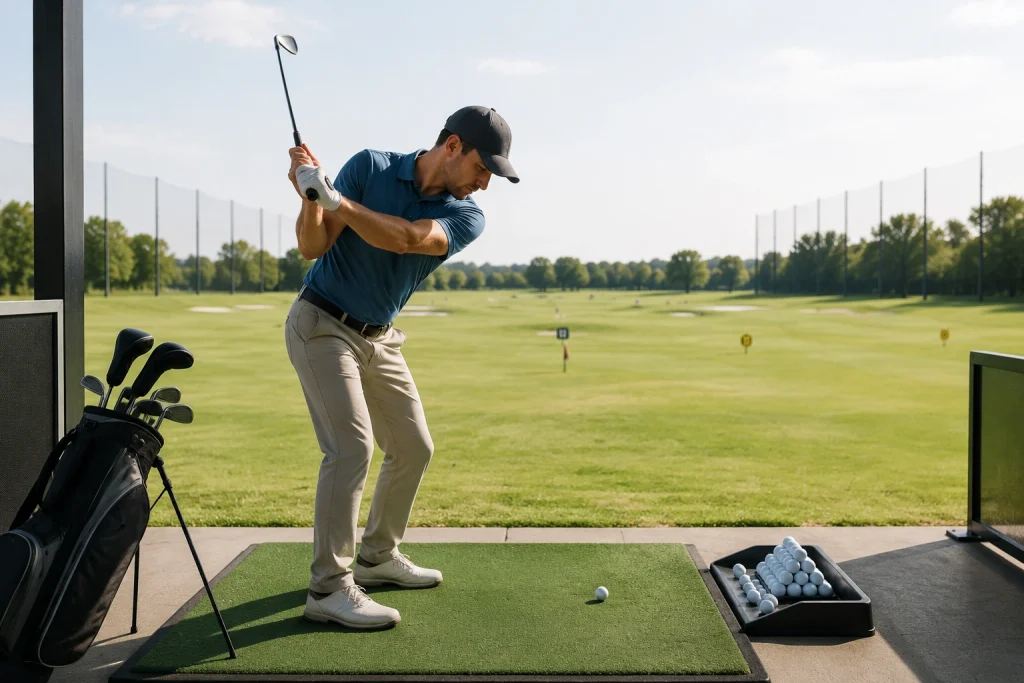
Start With Half Swings
Before attempting full-speed drives, learn to strike the ball with a waist-high backswing and waist-high follow-through.
Use a 7-iron or pitching wedge and focus on:
- Balanced posture
- Light grip pressure
- Smooth rhythm
- Centered contact
- A stable finish
Once you can make reasonable contact, gradually lengthen the swing.
Let the Body and Arms Work Together
During the backswing, allow your shoulders and upper body to turn while your arms move the club away from the ball.
During the downswing, shift pressure toward your lead side and rotate through the shot. Do not try to hit the ball using only your hands.
The ball should simply be in the path of the swinging club.
Swing Smoothly Before Swinging Hard
Most beginners assume more effort creates more distance. In reality, excessive effort often causes poor balance, off-center contact, and reduced clubhead speed.
A smooth strike from the middle of the clubface can travel farther than a hard swing that contacts the heel, toe, or top of the ball.
Expert Tip: Practice at approximately 60–70% effort until you can finish each swing in balance. Speed becomes useful only after you can control the clubface and contact point.
Learn the Short Game Early
The short game includes pitching, chipping, bunker shots, and putting. These shots occur close to the green and usually require less physical effort than a full swing.
Chipping
A chip is a low shot that spends more time rolling than flying.
For a basic chip:
- Use a narrow stance.
- Place slightly more pressure on your lead foot.
- Keep your hands slightly ahead of the ball.
- Make a short, controlled motion.
- Allow the ball to land on the green and roll toward the hole.
Choose a landing point rather than staring only at the flag.
Pitching
A pitch flies higher and travels farther through the air than a chip. Use it when you must carry rough, a bunker, or another obstacle.
Pitching requires more wrist movement and a longer swing, so begin with short pitches before attempting high or delicate shots.
Putting
Putting is mainly about controlling direction and distance.
Focus on:
- A stable lower body
- A comfortable grip
- A square putter face
- Smooth acceleration
- Finishing the stroke instead of hitting sharply at the ball
For long putts, prioritize distance control. Finishing close to the hole is more realistic than trying to make every putt.
Your First Beginner Practice Plan
Randomly hitting a bucket of balls is not the most efficient way to improve. A structured 60-minute session is more useful.
| Practice area | Time | Main objective |
|---|---|---|
| Warm-up and short pitches | 10 minutes | Develop rhythm and contact |
| Half-swings with a wedge | 10 minutes | Control the low point |
| Mid-iron practice | 15 minutes | Build repeatable contact |
| Hybrid or fairway wood | 10 minutes | Learn longer-club control |
| Chipping | 5 minutes | Select a landing point |
| Putting | 10 minutes | Improve start line and distance |
Do not judge progress only by your best shot. Pay attention to how often you produce a playable result.
A useful beginner goal is not “hit every ball perfectly.” It is “reduce the number of very poor shots.”
What to Expect on Your First Golf Course Visit
A short course, par-3 course, or nine-hole course is often a better starting point than a difficult championship layout.
Before booking, ask:
- Are beginners welcome?
- Is there a dress code?
- Are rental clubs available?
- Can you play nine holes?
- What is the expected pace?
- Are golf carts required?
- Is there a practice area?
Arrive early enough to check in, organize your bag, warm up, and reach the first tee without rushing.
Choose the Correct Tees
Play from a tee distance that allows you to reach greens with reasonable shots. The shortest available tees are not a sign of weakness. They are a way to keep the game enjoyable and maintain pace.
Move farther back only when your distance and control justify it.
Keep Up Without Feeling Rushed
You do not have to play well, but you should remain aware of the group behind you.
Helpful pace-of-play habits include:
- Prepare while another player is hitting.
- Bring more than one club when walking to your ball.
- Limit time spent searching for a lost ball.
- Record scores after leaving the green.
- Play a provisional ball when the first may be lost.
- Pick up after reaching an agreed maximum score.
“Ready golf” allows a player who is prepared to play when it is safe, rather than following a rigid order in casual stroke play. The R&A’s guidance on ready golf emphasizes that playing out of turn should never endanger, distract, or interfere with another player. (Randa)
Basic Golf Rules and Etiquette
You do not need to memorize the complete rulebook before playing. Learn the situations you will encounter most often.
The official principles include playing the course as you find it, playing the ball as it lies, and acting within the spirit of the game. Beginners can learn common situations through the free USGA Rules 101 course, which is organized into introductory lessons and practical modules. (USGA Rules)
Essential Beginner Etiquette
- Remain quiet and still while someone is hitting.
- Never hit when people are within range.
- Shout “Fore!” immediately if your ball may strike someone.
- Repair pitch marks on greens.
- Replace or repair divots when appropriate.
- Rake bunkers after use.
- Avoid standing on another player’s putting line.
- Keep carts away from restricted and sensitive areas.
- Follow all course signs and staff instructions.
Safety comes before score or pace. Never attempt a shot when another person, maintenance worker, vehicle, house, or public area could be endangered.
The full R&A Rules of Golf can be consulted when an unfamiliar situation occurs, but beginners should first become comfortable with penalties, lost balls, relief areas, bunkers, penalty areas, and putting-green procedures. (Randa)
Choosing Golf Balls, Gloves, Shoes, and Accessories
Golf Balls
Beginners lose golf balls frequently, so premium tour-level balls are rarely necessary.
Choose an affordable, durable ball that feels comfortable around the green. Using the same general ball model can make distance and feel more predictable, but consistency matters more after your swing becomes repeatable.
Avoid buying heavily damaged balls. Deep cuts, cracks, and severe surface wear can affect performance.
Golf Glove
A glove can improve grip and reduce friction. Right-handed golfers normally wear a glove on the left hand, while left-handed golfers normally wear one on the right.
The glove should fit closely without restricting movement. Replace it when it becomes stretched, slippery, stiff, or torn.
Golf Shoes
Golf-specific shoes provide traction, but beginners can often start in stable athletic shoes if the course permits them.
Avoid footwear with poor grip, especially on wet slopes. When buying golf shoes, prioritize comfort, waterproofing, stability, and correct sizing over appearance.
Useful Accessories
Bring:
- Tees
- Ball marker
- Divot repair tool
- Water
- Sunscreen
- Small towel
- Rain layer
- Extra balls
- Pencil or scoring app
Do not overload your bag. Carry what helps you play safely and comfortably.
When to Get Help From a Golf Pro or Fitter
A golf professional can help you understand your setup, ball flight, clubface position, and movement patterns before poor habits become established.
Consider a lesson when:
- You repeatedly miss the ball.
- Contact remains painful or uncomfortable.
- Most shots curve severely in one direction.
- You cannot identify why the ball stays low or goes sideways.
- Online swing advice creates more confusion.
- You are preparing for your first course round.
- You have a physical limitation or previous injury.
A short series of lessons is often more productive than buying a new driver to solve a swing problem. The PGA of America coach directory can help golfers find instructors based on their experience and learning needs. (PGA of America)
When Club Fitting Becomes Useful
A complete custom fitting may not be necessary during your first few practice sessions. However, basic fitting advice is valuable when:
- Standard clubs feel unusually long or short.
- You are significantly taller or shorter than average.
- The shaft feels extremely heavy or difficult to control.
- You have limited mobility or strength.
- Your clubs consistently produce uncomfortable contact.
- You are ready to invest in a long-term set.
A fitter can evaluate club length, lie angle, shaft weight, shaft flex, grip size, loft gapping, and set composition.
Equipment cannot replace sound technique. Fitting works best when it supports a reasonably repeatable swing rather than attempting to correct every swing fault through hardware.
Common Mistakes Golfers Should Avoid
- Buying expensive equipment too early: Your preferences may change as your swing develops.
- Trying to hit every shot at maximum power: Excess effort often reduces balance and contact quality.
- Learning only with a driver: Wedges, irons, chips, and putts build more transferable skills.
- Ignoring the short game: Putting and shots around the green affect every round.
- Using too many swing thoughts: Focus on one simple change during each practice session.
- Copying advanced players blindly: A movement that works for a skilled golfer may not solve your problem.
- Choosing tees that are too long: Excessive course length creates slow, frustrating rounds.
- Failing to warm up: Begin with small swings before attempting full-speed shots.
- Standing too close to another golfer: Give players enough space and remain outside their swing area.
- Continuing through pain: Stop when a movement causes sharp or increasing pain.
- Taking practice swings that damage the course: Use designated practice areas and avoid unnecessary divots.
- Becoming obsessed with score: Early progress should be measured by contact, control, confidence, and decision-making.
FAQs
Is golf difficult for complete beginners?
Golf can be challenging because the ball is small and the swing involves several coordinated movements. However, beginners can enjoy the game immediately by using shorter courses, forgiving equipment, simple goals, and realistic scoring expectations.
What golf club should a beginner learn first?
A 7-iron or pitching wedge is a good starting club. Both are shorter and easier to control than a driver. They allow beginners to practice posture, grip, balance, and centered contact.
Do beginners need a full set of golf clubs?
No. A partial set containing a wood, hybrid, mid-iron, wedge, and putter is enough for early practice and short-course play. Additional clubs can be added as your distance gaps and preferences become clearer.
How often should a beginner practice golf?
Two or three focused sessions per week can produce steady improvement. Even 20–30 minutes of putting, chipping, or half-swing practice is useful when the session has a clear purpose.
Should beginners take golf lessons?
Lessons are especially helpful for learning grip, setup, alignment, safe movement, and basic ball-flight principles. One early lesson can prevent months of practicing an inefficient habit.
When should a beginner play on a real golf course?
Consider playing after you can make basic contact, move the ball forward safely, putt, and understand essential etiquette. A par-3 or nine-hole course is usually the most comfortable first experience.
What is a good score for a beginner golfer?
There is no single correct beginner score. Course difficulty, length, weather, and experience all matter. Focus first on finishing holes safely, reducing lost balls, limiting repeated shots, and maintaining pace.
Conclusion
Golf becomes much easier to understand when you stop trying to learn everything at once. Begin with a small set of forgiving clubs, develop a balanced setup, practice short controlled swings, and spend time on chipping and putting.
As you move from the range to the course, choose beginner-friendly tees, follow basic etiquette, and measure progress through better contact and smarter decisions rather than perfect scores.
The best approach to golf for complete beginners is simple: learn one skill at a time, practice with a clear purpose, and ask a qualified coach or fitter for help when guessing is no longer productive. Choose your first practice session, take one comfortable club, and start building a swing you can trust.