
Foursomes Explained: How Alternate Shot Golf Works

Quick Answer
Foursomes is a golf format where two partners play as one side and alternate strokes on a single ball. One player starts the first hole, the other starts the next hole, and that teeing order keeps alternating throughout the round. The official Rule 22 for foursomes also requires partners to keep alternating after every counted stroke until the ball is holed.
Foursomes rules at a glance
- One ball: Both partners play the same ball for their side on each hole.
- Alternate strokes: Player A hits, then Player B, then Player A again until the hole ends.
- Alternate tee shots: The partners take turns playing first from the teeing area on successive holes.
- Penalty strokes: A penalty does not change which partner must make the next actual stroke.
- Match or stroke play: Foursomes can be used in either form of competition.
Best beginner tip
- Before the round, decide who starts and practice saying whose turn is next after every unusual situation.
If you have watched the Ryder Cup, you have probably seen foursomes without realizing how different it feels from normal golf. It is usually called alternate shot, and the format makes every decision a shared one.
I like foursomes because it strips golf down to partnership, patience, and smart course management. This guide explains exactly how foursomes works, the rules that cause the most confusion, and the strategy that makes a partnership more effective.
In This Guide
What Is Foursomes in Golf?
Foursomes is an alternate-shot format in which two partners compete as one side using a single ball. The partners take turns making strokes until the hole is completed.
Definition: In golf, foursomes means two partners play one ball in alternating order on each hole. The format may be played as match play or stroke play.
The name can confuse beginners. A “foursome” in casual golf often means any group of four players, while Foursomes in the Rules of Golf describes a specific competitive format.
In a typical match, two players form Side A and two form Side B. Each side has only one ball being played at a time.
- Player A1 plays the opening tee shot for Side A.
- Player A2 plays Side A’s second stroke.
- Player A1 plays the third stroke.
- The sequence continues until the ball is holed.
Side B follows the same process with its own ball. That means a four-player foursomes match normally has only two balls being played between the two sides.
Why is it called alternate shot?
The alternate-shot name describes the format more clearly than “foursomes.” After one partner makes a stroke, the other partner must make the next counted stroke.
You cannot simply let the better iron player hit every approach or the better putter finish every hole. The order of play controls who gets each shot.
Where do you see foursomes played?
Foursomes is especially well known from international team golf. The Ryder Cup uses alternate-shot sessions alongside Four-Ball and Singles.
Club competitions also use the format because it creates genuine teamwork. It can move faster than a four-player individual format because each partnership plays only one ball.
Section Takeaway: Foursomes is true alternate shot. Two partners become one side, share one ball, and take turns making every counted stroke.
How Does Foursomes Work?
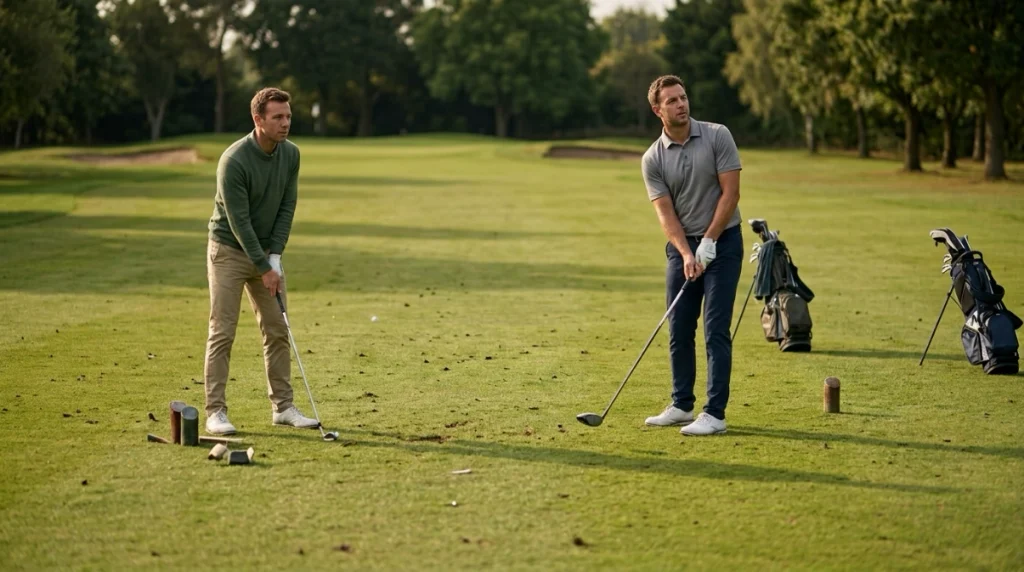
The simplest way to understand foursomes is to separate teeing order from shot order. Partners alternate who starts each hole, then alternate every stroke until that hole is finished.
Step 1: Choose who starts the round
Unless the competition’s Terms say otherwise, a side may choose which partner plays first from the opening teeing area. That decision establishes the alternating pattern for later holes.
If Player A starts Hole 1 during a normal 18-hole round beginning on the first tee, Player B starts Hole 2. Player A then starts Hole 3, and the pattern continues.
- Hole 1: Player A tees off.
- Hole 2: Player B tees off.
- Hole 3: Player A tees off.
- Hole 4: Player B tees off.
The same idea applies if a competition begins on another hole. What matters is alternating who plays first from the teeing area on successive holes.
Step 2: Alternate every stroke
Suppose Player A drives on the first hole. Player B must play the next stroke from wherever that drive finishes.
If Player B hits the approach onto the green, Player A takes the first putt. If Player A misses, Player B plays the next putt.
- A hits the tee shot.
- B hits the approach.
- A hits the first putt.
- B holes the next putt.
The side records four strokes in that example. The next hole starts with the partner assigned to tee off there, regardless of who holed the previous putt.
Does the person who holes out determine the next tee shot?
No. This is one of the most common beginner mistakes.
The next hole’s teeing order comes from the alternating-hole pattern. It does not depend on who hit the final putt on the previous hole.
Can either partner mark or drop the ball?
Yes. Rule 22 allows either partner to take permitted actions for the side, such as marking, lifting, replacing, dropping, or placing the ball.
That does not change the stroke order. The partner whose turn it is must still make the next stroke.
Can partners share golf clubs?
Partners may share clubs in foursomes if they have no more than 14 clubs between them in total. That differs from the normal situation where an individual player may carry up to 14 clubs.
Most established players still use their own sets. The rule matters more when partners intentionally plan a shared setup.
Section Takeaway: Decide the starting player, alternate teeing responsibility by hole, and alternate every counted stroke after the tee shot.
What Happens With Penalties or Playing Out of Turn?
Penalty strokes do not change the partners’ playing order in foursomes. The next actual stroke must still be made by the partner whose turn it was before the penalty was added.
This is where alternate shot becomes harder than it looks. A strange rules situation can make both partners second-guess the order.
Do penalty strokes change whose turn it is?
No. Imagine Player A hits into a penalty area and the side takes a one-stroke penalty.
If Player B was due to make the next stroke, Player B still plays it. The penalty counts toward the score but does not act like a stroke made by either partner.
Who plays a provisional ball?
If the side chooses to play a provisional ball, it must be played by the partner whose turn it is to make the side’s next stroke. The provisional does not reset the alternating order.
This is worth discussing before a competitive round. Under pressure, it is surprisingly easy to reach for a ball before checking whose turn it is.
What if a stroke must be replayed?
If a stroke is cancelled, replayed, or otherwise does not count under a Rule, the same partner generally plays again. A stroke that does not count has not moved the alternate-shot sequence forward.
The safest approach is to stop whenever a ruling changes whether the previous stroke counts. Confirm the status of the stroke before anyone plays again.
What happens if the wrong partner plays?
Playing in the wrong order breaches Rule 22.3 and brings the general penalty. In match play, the general penalty is loss of hole.
Stroke play requires another step. The side must correct the mistake using the proper player from the location where the first wrong-order stroke was made.
- The correct partner plays from the required spot.
- The wrong-order stroke does not count toward the corrected score.
- Further strokes made with that wrongly played ball before correction also do not count.
- Failing to correct in time can lead to disqualification.
The full procedure is covered in the USGA’s Rule 22 guidance. For competition golf, I would check the rule before guessing.
Can one partner cause a penalty for the whole side?
Yes. Because the two players compete as one side, certain actions or breaches by either partner can affect the side.
That shared responsibility is another reason communication matters. In foursomes, your partner’s rules mistake can become your problem too.
Section Takeaway: A penalty stroke never changes the alternating order. When a stroke is cancelled or someone plays out of turn, check Rule 22 before continuing.

Foursomes vs Four-Ball: What Is the Difference?
Foursomes uses one ball per two-player side, while Four-Ball lets each partner play a separate ball. That single difference changes the rhythm, scoring, and strategy of the entire round.
Golf broadcasts sometimes make the terms sound interchangeable. They are not.
| Format | Balls Per Two-Player Side | How Players Hit | Side’s Result |
|---|---|---|---|
| Foursomes | 1 | Partners alternate strokes | Score or match result from the shared ball |
| Four-Ball | 2 | Each partner plays their own ball | Lower partner score counts for the side |
| Singles | 1 per player | Each golfer plays independently | Individual player’s result |
Why is Four-Ball more forgiving?
Four-Ball gives a partnership two chances on each hole because each player plays their own ball. The side normally uses the lower of the partners’ scores for that hole.
If one golfer finds trouble, the other may still make par or birdie. The official structure is covered under USGA Rule 23 for Four-Ball.
Why does foursomes feel harder?
Every shot directly determines what your partner faces next. A poor drive does not leave you with a recovery shot; it leaves your partner with one.
That changes decision-making. Aggressive golf can feel less attractive when somebody else must deal with the consequences.
Is foursomes the same as a scramble?
No. In a typical scramble, both partners hit and the side chooses a preferred shot before everyone plays again from that location.
Foursomes gives you no choice between two shots. Only one ball is being played, and the partners must follow the alternate-stroke sequence.
Section Takeaway: Four-Ball gives each partner their own ball. Foursomes gives the partnership one ball, making every stroke part of a shared chain.
What Is the Best Strategy for Foursomes?

Good foursomes strategy favors position, predictable misses, and clear communication over unnecessary aggression. Your goal is to give your partner playable shots as often as possible.
That sounds obvious, but alternate shot changes how golfers process risk. The shot you attempt is often a shot your partner must live with.
Choose the tee order by hole fit
Do not automatically give the longer hitter every possible driving opportunity. Look at which holes each player will start and match those holes to each golfer’s strengths.
Consider these factors before choosing who opens the round:
- Driving accuracy: Who handles the tighter tee-shot holes better?
- Shot shape: Does one player’s natural curve fit certain doglegs?
- Par-3 comfort: Which partner suits the likely iron distances?
- Risk holes: Who is more comfortable around forced carries or hazards?
- Closing stretch: Which player would you prefer hitting specific late tee shots?
I would rather create eight or nine comfortable tee shots for each partner than chase one theoretical distance advantage. Predictability is powerful in alternate shot.
Keep the ball in play
PGA coaching advice on alternate shot emphasizes steady, conservative decision-making because the consequences of risk fall directly on the partner. Their foursomes strategy guidance makes the same basic point.
That does not mean playing scared. It means choosing aggressive shots only when the potential reward justifies the position you could leave behind.
Think one shot ahead
A good target is not always the spot that leaves the shortest next shot. Sometimes the better target gives your partner a distance or lie they handle more comfortably.
For example, laying back to a full wedge yardage can be smarter than chasing a narrow opening near the green. Your partner may prefer the fuller swing.
Communicate before the shot
Strong partners make decisions together without filling every shot with advice. Discuss the important variables, then let the player over the ball commit.
- Confirm the target.
- Agree on the safest miss.
- Check wind and yardage.
- Discuss whether trouble changes the club choice.
- Let the player hit without late second-guessing.
Putting deserves the same discipline. Too many opinions can create doubt when one partner already sees the line clearly.
Practice the format, not just your swing
Alternate-shot practice exposes situations that normal range sessions never create. You may hit a drive, wait several minutes, then face a six-foot putt without hitting the approach.
Play a few holes in true foursomes order before an important event. The unusual rhythm becomes much easier once you have experienced it.
Stop apologizing for every bad shot
This is the mental lesson I value most. Foursomes becomes exhausting when every miss produces an apology and every recovery creates pressure to “pay your partner back.”
A poor shot is simply the side’s new situation. Talk about the next decision and move on.
Pro tip: If shot selection or swing changes are becoming complicated, work with a certified PGA Professional rather than rebuilding technique during a competitive foursomes round.
Section Takeaway: The best foursomes teams manage position, choose tee assignments carefully, communicate simply, and treat every bad shot as a shared problem rather than one player’s failure.
Foursomes Golf FAQ
Is foursomes the same as alternate shot?
Yes. Under the Rules of Golf, foursomes is also known as alternate shot. Two partners play as one side, use one ball, and make strokes in alternating order until each hole is completed.
Who tees off first in foursomes?
Unless the Terms of the Competition specify the order, the side may choose which partner starts the round. The partners then alternate who plays first from the teeing area on successive holes.
Does a penalty stroke change whose turn it is?
No. Penalty strokes do not change the partners’ alternating order. The golfer who was due to make the next actual stroke remains the player who must play next.
Can foursomes be played as stroke play?
Yes. Foursomes can be played as either match play or stroke play. The basic alternate-shot sequence stays the same, although penalties and competition procedures can differ between the two forms.
Can foursomes partners share clubs?
Yes. Rule 22 permits partners to share clubs as long as the partners have no more than 14 clubs between them in total.
What happens if the wrong player hits in foursomes?
The side receives the general penalty for playing in the wrong order. In stroke play, the mistake must also be corrected using the proper player from the required location before the applicable correction deadline.
Is foursomes the same as Four-Ball?
No. Foursomes uses one shared ball and alternating strokes. In Four-Ball, both partners play their own balls and the lower partner score normally becomes the side’s score for the hole.
Final Takeaway
Foursomes looks simple because only one ball is involved, but the format demands more teamwork than almost any other common form of golf. Every drive, recovery, approach, chip, and putt becomes part of one continuous partnership.
Remember the essentials: alternate teeing responsibility, alternate every counted stroke, and do not let penalty strokes change the order. Once those rules become automatic, you can focus on the part that makes foursomes fun—solving the golf course together.
If you are playing the format for the first time, spend a few minutes planning tee assignments and communication before you start. A calm partnership usually beats two golfers trying to play hero golf on every shot.