
Stableford Explained: How the Golf Scoring System Works

Quick Answer
Stableford is a form of stroke play where you earn points on each hole instead of simply adding every stroke for the round. Under the standard system, par normally earns two points, birdie three, bogey one, and a score more than one over the target earns zero; the golfer with the most total points wins. The official R&A Stableford rules appear under Rule 21.1.
Standard Stableford points
- Double bogey or worse: Zero points when par is the fixed target.
- Bogey: One point.
- Par: Two points.
- Birdie: Three points.
- Eagle: Four points.
- Albatross: Five points.
The key idea
- Once you can no longer earn a point on a hole, you can usually pick up and move on.
Stableford looks unusual the first time you see points beside golf scores. Once you understand the two-points-for-par baseline, though, the format becomes surprisingly simple.
I like Stableford because one ugly hole does not have to wreck an otherwise good round. This guide explains the scoring system, handicaps, scorecards, strategy, and the differences from regular stroke play.
In This Guide
What Is Stableford in Golf?
Stableford is a points-based form of stroke play. Your score on each hole is compared with a fixed target, which is normally par unless the competition Committee sets another target.
The player or side with the highest total number of points wins. That reverses the usual mindset of golf scoring, where a lower stroke total is better.
Definition: Stableford converts your result on each hole into points according to how many strokes you finish above or below the fixed target score.
Why does Stableford feel different from normal golf scoring?
Regular stroke play makes every stroke part of your final total. A disastrous hole can therefore follow you all the way to the clubhouse.
Stableford limits that damage. Once your score becomes too high to earn a point, making another three or four strokes does not reduce your Stableford total further.
- Good holes earn more: Birdies and eagles increase your points.
- Bad holes have a floor: The lowest hole result is zero points.
- The highest total wins: More Stableford points are better.
- Picking up is possible: You do not need to keep playing when zero points are inevitable.
This feature can make the format friendlier for club competitions and mixed-ability groups. It also prevents a single blow-up hole from dominating the entire round.
Is Stableford officially a form of stroke play?
Yes. The USGA Rule 21 overview defines Stableford as a form of stroke play with scoring modified by points.
The ordinary stroke-play Rules still apply unless Rule 21.1 changes how a particular situation is handled. Penalty strokes, for example, still count when determining the hole score.
How Does Stableford Scoring Work?
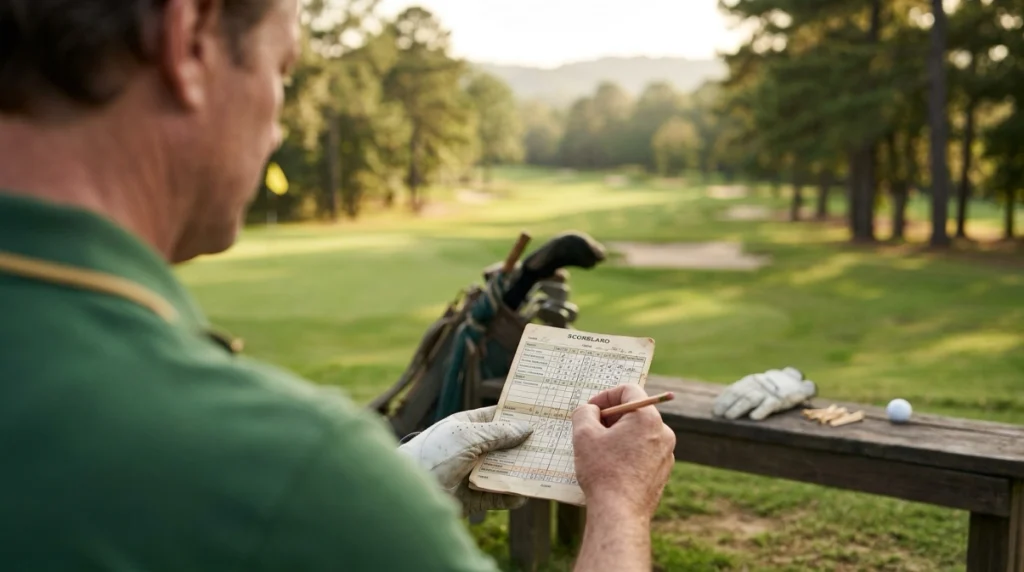
You calculate Stableford points by comparing your hole score with the fixed target score. Par is normally used as that target.
Two points represent the target score. You then gain or lose points as your score moves below or above that target.
| Result vs Fixed Target | If Target Is Par | Points |
|---|---|---|
| More than one over | Double bogey or worse | 0 |
| One over | Bogey | 1 |
| Target score | Par | 2 |
| One under | Birdie | 3 |
| Two under | Eagle | 4 |
| Three under | Albatross | 5 |
| Four under | Four under par | 6 |
What happens if you cannot score a Stableford point?
If your score will result in zero points, you can stop playing that hole. The Rules encourage this because it can improve pace of play.
For example, imagine a scratch Stableford event with par as the target. Once you cannot make better than double bogey, continuing the hole cannot improve your Stableford result.
You can therefore pick up and move toward the next tee. Your result for that hole remains zero points.
Can a Stableford competition use different point values?
Yes. Always read the Terms of the Competition before assuming the standard table applies.
A Committee may establish a different fixed target score. Events described as Modified Stableford may also use a different points scale to reward aggressive scoring or penalize poor holes differently.
- Confirm the fixed target score.
- Check the point values.
- Check whether handicaps apply.
- Check the tie-breaking procedure.
The competition’s published terms control the format. Do not assume every event carrying the Stableford name uses identical scoring.
How Does Handicap Stableford Work?
In handicap Stableford, handicap strokes adjust your hole score before the Stableford points are calculated. This allows golfers of different playing abilities to compete using net scores.
The important number in a competition is your Playing Handicap. The USGA explains that this is the actual number of strokes you receive or give for that game or competition.
Where do you receive handicap strokes?
Handicap strokes are assigned according to the course’s stroke index allocation. A hole marked stroke index 1 receives a handicap stroke before a hole marked stroke index 18 when strokes are being allocated across all 18 holes.
You can review the USGA’s explanation of stroke index allocation for the handicapping principles behind that order.
Suppose your Playing Handicap gives you 18 strokes. In a typical 18-hole allocation, you receive one stroke on each hole.
A gross bogey on a hole where you receive one stroke becomes a net par. That net par is worth two Stableford points when par is the fixed target.
What if you receive more than 18 strokes?
A golfer receiving 24 strokes gets one stroke on every hole, plus another stroke on six holes. Those extra strokes normally fall on stroke-index holes 1 through 6.
Consider a par-4 hole where you receive two strokes. A gross 6 becomes a net 4, which equals net par and earns two points.
- Gross 5 with one stroke: Net 4, or two points on a par 4.
- Gross 6 with two strokes: Net 4, or two points on a par 4.
- Gross 4 with one stroke: Net 3, or three points on a par 4.
Is a 36-point Stableford round good?
Thirty-six points is a useful reference in a handicapped round where net par earns two points. Eighteen net pars would produce 36 points.
That does not guarantee every event treats 36 identically. Playing Handicap calculations, allowances, competition conditions, and the chosen scoring system can affect the context.
The USGA Playing Handicap guide is worth checking if you are unsure which handicap number applies to a competition.

What Does a Stableford Scorecard Look Like?
A Stableford scorecard usually records your strokes and the points earned for each hole. In a handicap event, the scoring process also accounts for strokes received on the relevant holes.
Here is a simple six-hole example with par as the fixed target. For clarity, this example uses scratch scoring.
| Hole | Par | Score | Result | Points |
|---|---|---|---|---|
| 1 | 4 | 4 | Par | 2 |
| 2 | 3 | 4 | Bogey | 1 |
| 3 | 5 | 4 | Birdie | 3 |
| 4 | 4 | 6 | Double bogey | 0 |
| 5 | 4 | 3 | Birdie | 3 |
| 6 | 3 | 3 | Par | 2 |
The golfer scores 11 points across those six holes. Notice how the double bogey costs only the opportunity to earn points on that hole.
The two later good holes immediately put points back on the card. That reset is one reason I find Stableford easier to enjoy after a poor hole.
Do you have to hole out in Stableford?
You must hole out when your score can still earn points if you want those points credited. Once the hole can only produce zero points, Rule 21.1 allows the hole to be completed without holing out.
The Committee handles the official points calculation. Always follow the event’s scorecard instructions, especially when the round will also be submitted for handicap purposes.
Stableford vs Stroke Play: What Is the Difference?
The biggest difference is what ultimately determines the winner. Traditional stroke play rewards the lowest total number of strokes, while Stableford rewards the highest number of points.
| Feature | Stableford | Regular Stroke Play |
|---|---|---|
| Scoring | Points by hole | Total strokes |
| Winner | Highest points | Lowest strokes |
| Bad hole | Falls to zero points | Every stroke stays in total |
| Picking up | Possible once no points remain | Normally must hole out |
| Mindset | Build points hole by hole | Protect total stroke score |
Why can Stableford improve pace of play?
A golfer making a huge number in ordinary stroke play may need to continue until the ball is holed. Stableford removes that need once the hole cannot produce any points.
A group that uses this rule properly can avoid watching one player grind through several unnecessary recovery shots. The next hole becomes a fresh scoring opportunity.
Does Stableford reward aggressive golf?
It can encourage aggression in the right situation, but standard Stableford does not make reckless decisions automatically worthwhile. Losing a likely two-point par while chasing a three-point birdie still matters.
The better approach is to compare risk with the number of points realistically available. That makes Stableford strategy more interesting than simply attacking every flag.
How Should You Play a Stableford Round?

A good Stableford strategy starts with protecting easy points. Pars and bogeys can build a competitive total without requiring spectacular golf.
I prefer to think in points before difficult shots. The question becomes, “What gives me the best chance of leaving this hole with something?”
1. Know where you receive handicap strokes
Mark your stroke holes before teeing off. This prevents confusion when calculating whether a gross bogey is really a net par or birdie.
It also changes strategy. A tough hole where you receive a stroke may be a perfectly good place to play conservatively for two net points.
2. Protect two-point holes
Two points for net par form a useful foundation in standard handicap Stableford. Do not throw them away with a low-percentage shot unless the potential gain makes sense.
- Choose a club that keeps the tee shot in play.
- Aim away from severe trouble when necessary.
- Take sensible penalty relief instead of attempting miracle recoveries.
- Think about the next shot before chasing the flag.
3. Recognize when birdie is worth chasing
A genuine birdie opportunity can justify a more attacking approach because moving from par to birdie adds another point. The decision still depends on the downside.
A short approach from the fairway may deserve an aggressive target. A recovery shot through a tiny gap in trees usually presents a very different calculation.
4. Pick up when the hole is over
Do not keep grinding after you cannot earn a point. Picking up is built into the Stableford format and helps everyone maintain pace.
Reset immediately. One zero does not stop you from making three points on the next hole.
5. Keep counting points until the end
Stableford rounds can change quickly because birdies add points while disasters stop at zero. A player who appears out of contention can recover through several strong holes.
Focus on the next available points rather than replaying the previous mistake. That mindset suits Stableford better than protecting a running stroke total.
Section Takeaway: Build your round around repeatable one- and two-point holes, then attack when the risk-to-reward calculation favors the extra point. A zero hurts, but it does not have to define the round.
Stableford FAQ
What is a good Stableford score?
In a common handicapped format where net par earns two points, 36 points equals two points across all 18 holes. Scores above or below that figure should still be judged in the context of the competition’s handicap allowance, field, course, and scoring terms.
Is Stableford gross or net?
Stableford can be played as either scratch or handicap competition. In scratch Stableford, gross hole scores determine points, while handicap Stableford applies the appropriate handicap strokes before calculating the points earned on each hole.
How many Stableford points is a birdie?
A birdie earns three points under standard Stableford when par is the fixed target score. In a handicap event, a golfer’s net score may produce a net birdie even when the gross score is higher.
How many points is an eagle in Stableford?
An eagle earns four points under the standard system when par is the fixed target. A score three under the target earns five points, while four under earns six points.
What happens with a double bogey in Stableford?
In scratch Stableford using par as the target, a double bogey earns zero points. In handicap Stableford, the player’s gross double bogey could become a net bogey or net par if handicap strokes are received on that hole.
Can you pick up your golf ball in Stableford?
Yes. Once your score on the hole can no longer earn more than zero points, the Rules encourage you to stop playing the hole. This is one reason Stableford can move faster than traditional stroke play.
Does the highest Stableford score win?
Yes. Stableford reverses the normal lowest-score-wins idea used in regular stroke play. The golfer or side that completes the competition with the most Stableford points wins.
Stableford becomes easy once you stop thinking only about total strokes. Protect the points available on each hole, understand where your handicap strokes fall, and move on quickly when a hole is lost.
If you are playing a Stableford competition in 2026, check the event terms before teeing off. Confirm the target score, handicap allowance, point system, and tie-breaking procedure so you know exactly what each hole is worth.