
Flagstick Rules in Golf: Complete 2026 Guide

Quick Answer
Under Rule 13.2 of the Rules of Golf, you may leave the flagstick in the hole, remove it, or have someone attend it. You must make that choice before your stroke, and there is normally no penalty when a ball accidentally hits a flagstick.
Flagstick Rules to Remember
- Flagstick can stay: You may putt or play another shot with the flagstick left in the hole.
- No automatic penalty: Your moving ball may hit a flagstick that you properly chose to leave in.
- Decide before playing: Choose whether the flagstick stays, comes out, or is attended before making your stroke.
- Do not manipulate it: You cannot deliberately position or move the flagstick to influence where your ball finishes.
- Accidental contact is different: A ball accidentally hitting an attended or removed flagstick normally brings no penalty.
- Check a ball against the stick: A ball touching the flagstick is not automatically holed.
Simple On-Course Habit
- Say “leave it,” “take it out,” or “attend it” before you settle over the ball.
Flagstick rules sound simple until a ball is rolling toward the cup and somebody reaches for the pin. That is where many casual-round arguments begin.
I prefer one easy habit: make the flagstick decision before anyone plays. This guide explains the current 2026 rules, including putting, accidental contact, attended flags, penalties, and balls resting against the stick.
In This Guide
What Are the Flagstick Rules in Golf?
Golf’s main flagstick requirements appear under Rule 13.2. They apply to a ball played from anywhere on the course, not only from the putting green.
The flagstick is the movable pole provided by the Committee and placed in the hole to show golfers its location. The flag and other permitted objects attached to that pole form part of the flagstick.
The most important point is choice. Before making your stroke, you may decide to:
- Leave the flagstick in the hole.
- Have the flagstick removed.
- Have someone attend the flagstick and remove it during or after your stroke.
The current USGA Rule 13 guidance follows the same framework. Simply striking a properly handled flagstick does not automatically create a penalty.
Flagstick Rule Scenarios at a Glance
| Situation | Allowed? | Normal Result |
|---|---|---|
| Putt with flagstick left in | Yes | No penalty if ball hits it |
| Remove flagstick before stroke | Yes | Play normally |
| Have another person attend flagstick | Yes | They should remove it as intended |
| Ball accidentally hits attended or removed flagstick | Possible | Normally no penalty; play as it lies |
| Move flagstick deliberately to affect moving ball | No | General penalty may apply |
A general penalty means loss of the hole in match play or two penalty strokes in stroke play. That makes deliberate interference much more serious than a harmless accidental touch.
Section Takeaway: Decide how the flagstick will be handled before making your stroke. Normal accidental contact is usually not the problem; deliberate manipulation is.
Can You Leave the Flagstick In While Putting?
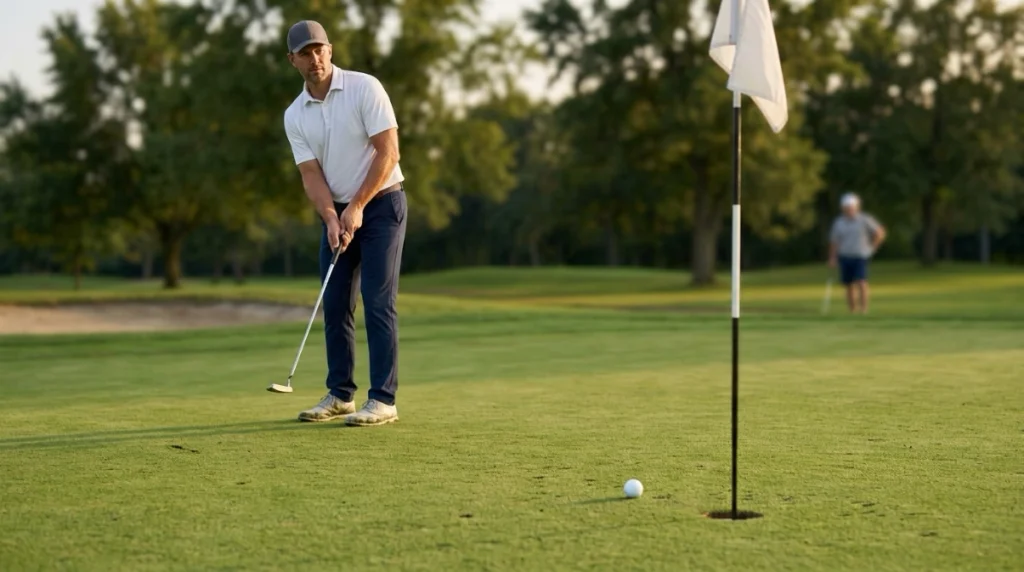
Yes. You may legally putt with the flagstick left in the hole, and there is no penalty merely because your putt hits it.
This is one of the most useful flagstick rules for everyday golfers. It applies whether the putt is three feet, thirty feet, or coming from off the green.
What changed in 2019?
Before the modernized Rules took effect in 2019, a ball played from the putting green striking an unattended flagstick in the hole could result in a penalty. That restriction was removed.
The USGA’s explanation of the 2019 change notes that golfers can now putt with the flagstick left in without that old penalty. The change also helps avoid unnecessary delays.
You still have a choice. Nothing in Rule 13.2 requires you to leave the flagstick in while putting.
Can you straighten the flagstick before putting?
You may leave the flagstick as you find it or move it so it is centered in the hole. You may also have a removed flagstick returned to the hole before playing.
What you cannot do is deliberately position it away from center because you believe that position will help your ball. If you do that and your moving ball hits the flagstick, the general penalty applies.
Should you putt with the flagstick in?
That is a preference rather than a Rules question. Some golfers like the visual target, especially on long putts, while others prefer seeing an open cup.
My practical approach is to avoid changing the plan once a player has begun their routine. Agreeing early also keeps a group moving without confusion around the hole.
- Long putt: Leaving it in can make the hole easier to see.
- Short putt: Many golfers prefer the flagstick removed, but it is optional.
- Fast play: Leaving it in can reduce unnecessary waiting.
- Competition: Follow Rule 13.2 rather than relying on old habits.
Section Takeaway: You can putt with the flagstick in throughout the round. The key is making that decision before the stroke rather than trying to change the outcome afterward.
What Happens If Your Ball Hits the Flagstick?
If you chose to leave the flagstick in and your moving ball hits it, there is normally no penalty. You play the ball from where it comes to rest unless another Rule requires something different.
The result does not change simply because the shot came from the putting green. Rule 13.2 applies to shots played from anywhere on the course.
What if the ball bounces out?
A ball striking the flagstick can drop into the cup, stop near it, or bounce away. When the flagstick was properly left in, you accept that outcome and continue from where the ball finishes.
You do not replay the putt because the flagstick changed the ball’s direction. The possibility of a helpful or harmful deflection is part of choosing to leave it in.
Can someone pull the flagstick while the ball is moving?
Not when the action is deliberately taken to affect where the moving ball might finish. A player or caddie who does that can cause the player to receive the general penalty.
For example, imagine a downhill putt racing toward the cup. You cannot suddenly tell your caddie to pull the flag because you now believe the ball will strike it.
The opposite strategy is also improper. You cannot deliberately insert or reposition a flagstick to create a backstop for a moving ball.
What if another golfer removes it?
Another player must not deliberately move or remove a flagstick you chose to leave in when the purpose is to affect your moving ball. Depending on the situation, that other player may receive the general penalty.
There is no automatic penalty when someone moves the flag for an unrelated reason. Intent and the circumstances matter.
Section Takeaway: A normal collision with the flagstick is usually penalty-free. The Rules become stricter when someone deliberately moves, positions, or uses the flagstick to influence a ball in motion.


When Can the Flagstick Be Removed or Attended?
You may have the flagstick removed before making a stroke. You may also authorize someone to attend it and remove it during or immediately after your stroke.
This is common when a player faces a long putt and wants the flagstick visible during setup. The attendant can show the hole location and then move the flagstick away.
What does attending the flagstick mean?
A person attending the flagstick normally holds it in, above, or next to the hole before the stroke. The person then removes it as the shot is played or after the stroke.
Authorization does not always require a formal request. Under Rule 13.2, several situations can mean the player has accepted that the flagstick is being attended.
- The player directly asks someone to attend it.
- The player’s caddie is holding it or standing immediately beside the hole.
- The player sees someone in position to attend it and plays without asking them to move.
What if the ball accidentally hits the person attending the flag?
If the ball accidentally strikes the attended or removed flagstick, the person attending it, or something that person is holding, there is normally no penalty. The ball is played as it lies.
That is different from a deliberate deflection. A person cannot intentionally leave the flagstick in the ball’s path or deliberately use their body or equipment to stop the shot.
Where should a removed flagstick be placed?
Place it somewhere that is unlikely to interfere with play. Avoid laying it where a ball could reasonably roll into it.
A removed flagstick deliberately positioned to deflect or stop a ball can create a Rules problem. Good etiquette and good Rules practice point in the same direction here.
Pro tip: In a competition, ask a referee or the Committee if you are unsure whether a flagstick action was deliberate or whether a penalty applies.
Section Takeaway: You may remove or attend the flagstick, but establish the plan before the stroke. Accidental contact is normally harmless; deliberate deflection is not.
What If the Ball Rests Against the Flagstick?

A ball resting against the flagstick is not automatically holed. You need to look at the position of the ball relative to the surface of the putting green.
Under Rule 13.2c, the important test is whether any part of the ball is below the putting-green surface while the ball rests against the flagstick.
When is the ball considered holed?
If any part of the ball is inside the hole and below the surface of the putting green, the ball is treated as holed. The entire ball does not need to be below the surface in this special situation.
That detail catches golfers out because the normal definition of a holed ball generally requires the whole ball to be below the green’s surface. Rule 13.2c creates a specific treatment for a ball resting against the flagstick.
What if no part of the ball is below the surface?
Then the ball is not holed. It remains in play and must be dealt with under the Rules.
If you remove the flagstick and the ball moves, there is no penalty simply because removing the stick caused that movement. The ball must be replaced on the lip of the hole.
Do not scoop the ball away too quickly
This is one situation where slowing down for a few seconds helps. Check the ball’s position before assuming the hole is finished.
If the ball is not treated as holed and you fail to complete the hole in stroke play, the consequences can become much more serious. Rule 13.2c specifically refers to the requirement to hole out.
- Part of ball below green surface: Ball is treated as holed.
- No part below surface: Ball is not holed.
- Flag removed and ball moves: No penalty for that movement; replace the ball on the lip.
- Unsure: Look closely before lifting the ball.
Section Takeaway: When a ball rests against the flagstick, look at the ball’s vertical position. Contact with the stick alone does not decide whether the ball is holed.
Flagstick Rules FAQ
Can you leave the flagstick in when putting in 2026?
Yes. Under Rule 13.2, you may putt with the flagstick left in the hole. If your ball then hits that properly positioned flagstick, there is normally no penalty, and you play the ball as it lies.
Is there a two-stroke penalty for hitting the flagstick?
Not simply for hitting a flagstick that you legally chose to leave in. A two-stroke penalty in stroke play can arise from certain deliberate Rule breaches because the general penalty is two strokes in stroke play.
Can you remove the flagstick after the ball has started moving?
You should not deliberately change your flagstick decision to influence a moving ball. If the stick was left in, intentionally removing or moving it to affect where your ball finishes can result in the general penalty.
Can another player tend the flagstick for you?
Yes. You may authorize another person to attend the flagstick. The person can hold it in, above, or near the hole before the stroke and then remove it during or after the stroke as intended.
What happens if a putt accidentally hits an attended flagstick?
If the contact is accidental, there is normally no penalty. The same general treatment applies when a moving ball accidentally hits the person attending or removing the flagstick, or something that person is holding.
Is a ball touching the flagstick automatically in the hole?
No. If the ball rests against the flagstick, at least part of the ball must be in the hole below the putting-green surface for it to be treated as holed under the special Rule 13.2c provision.
Are the flagstick rules different in match play?
The basic Rule 13.2 choices are the same. However, when the Rules call for the general penalty, that penalty means loss of hole in match play instead of the two penalty strokes used in regular stroke play.
Final Flagstick Rules Takeaway
The easiest way to avoid a flagstick penalty is to make your decision early. Leave it in, remove it, or have it attended before you make the stroke.
As of 2026, there is normally no penalty simply because your ball hits a flagstick left in the hole. The bigger danger comes from deliberately manipulating the flagstick after a ball is moving.
The R&A Rules resources include the current Rules and updated clarifications if an unusual tournament situation needs a closer ruling. The digital Rules are especially useful when something unexpected happens during a round.
For everyday golf, remember one simple routine: decide first, play second, and never move the flagstick to influence a moving ball.