
Release in Golf: How to Release the Club Through Impact

Quick Answer
The release in golf is the coordinated unhinging of the wrists, extension of the arms, and continued body rotation through and after impact. A good golf swing release is not a last-second wrist flip; it develops from good sequencing, clubface control, and an impact position where the body keeps moving through the shot. The PGA’s impact-position guidance is a useful reference for understanding how the hands and hips work together.
Quick Release Sequence
- Start relaxed: Use a secure grip without squeezing tension into your wrists and forearms.
- Sequence the downswing: Let pressure move toward your lead side while your lower body begins turning.
- Control the clubface: Avoid throwing the clubhead from the top or trying to square the face at the final instant.
- Keep rotating: Let your chest continue turning as your arms approach the impact area.
- Extend through: Allow your arms and wrists to unload naturally after the strike instead of scooping at the ball.
- Finish balanced: Complete the motion with your body facing the target and the club fully released.
How to Check It
- Record a slow half-swing from face-on. Look for continuous rotation, stable contact, and arm extension after impact rather than a sudden hand flip.
Few golf instructions cause more confusion than “release the club.” Some golfers hear that phrase and immediately try to roll their hands over as hard as possible.
I prefer a simpler way to look at it. The release should be the result of a well-organized swing, not a frantic move you add at the ball.
In This Guide
- What Does Release Mean in Golf?
- When Should You Release the Golf Club?
- What Should the Hands, Wrists, and Body Do Through Impact?
- What Are the Most Common Golf Release Mistakes?
- How Do You Practice a Better Golf Swing Release?
- Does the Release Change With Driver, Irons, and Wedges?
- FAQs About Release in Golf
What Does Release Mean in Golf?
The golf release is the way stored wrist angles, arm structure, and body rotation unwind as the club approaches impact and moves into the follow-through. It is a sequence rather than one single position.
Definition: The release in golf is the coordinated unloading of the club through the impact zone, including wrist unhinging, arm extension, appropriate forearm rotation, and continued body rotation.
The release does not mean flipping your wrists
A common mistake is treating release as an instruction to throw the clubhead past the hands before contact. That can turn a reasonable downswing into a scoop, thin shot, fat shot, or hook.
With a well-struck iron, the handle commonly remains ahead of the clubhead at impact. The clubhead is allowed to fully overtake later in the follow-through.
- Before impact: The wrists still retain useful structure as the arms move toward the ball.
- At impact: The clubface, path, strike, body rotation, and handle position come together.
- After impact: The arms extend while the wrists continue unloading and eventually rehinge.
Why the release matters
A functional release helps you deliver speed without relying on a desperate hit with the hands. It also helps the clubface return predictably relative to the swing path.
That doesn’t mean every good golfer releases the club identically. Grip style, wrist conditions, swing plane, shot shape, and body motion create different workable combinations.
- Clubhead speed: The club can continue accelerating through the hitting area.
- Face control: The clubface has less need for a last-second correction.
- Strike quality: The golfer can maintain better low-point and contact control.
- Consistency: Larger body movements and arm motion can support the smaller wrist movements.
Classic instruction sometimes describes release as the arms and wrists working freely through the ball. Annika Sorenstam’s Golf Digest release guidance also connects a good release with grip, reduced tension, and a complete motion through the target.
Section Takeaway: A good release is an unloading sequence through impact and the follow-through. It is not a conscious scoop or violent wrist roll at the golf ball.
When Should You Release the Golf Club?

You should not try to identify one exact millisecond when the release begins. The club starts unloading before impact and continues releasing well after contact.
The useful question is whether the release occurs in the correct sequence. Trying to manually time it usually creates another compensation.
Checkpoint 1: Delivery position
As the hands approach roughly hip height in the downswing, the club should still have structure. You do not want the wrists to have dumped every angle immediately from the top.
- Pressure is moving toward the lead side.
- The body has begun opening toward the target.
- The trail wrist normally retains some bend.
- The clubface is controlled enough that no emergency flip is required.
Checkpoint 2: Impact
Impact is not where you deliberately stop the wrists. It is simply the point the ball happens to meet a continuously moving club.
For a typical iron shot, the hands are commonly ahead of the clubhead while the body continues rotating. Driver delivery looks different because ball position and desired attack conditions are different.
Checkpoint 3: Post-impact extension
Immediately after impact, the arms should have room to extend rather than collapse against the body. The wrists keep unloading as the club moves around toward the finish.
This area is often easier to train than impact itself. The ball is gone quickly, but you can rehearse and hold a post-impact position.
- Too early: The club’s angles disappear near the start of the downswing.
- Too late: The golfer tries to drag the handle indefinitely and prevents the club from releasing.
- Well sequenced: The club unloads progressively while the body, arms, and wrists keep moving.
Trying to “hold lag” forever can be just as unhelpful as casting. Lag is better treated as a result of sequencing than a position you force into impact.
Section Takeaway: The release happens across a window, not at one magic point. Your goal is progressive unloading before, through, and after impact.
What Should the Hands, Wrists, and Body Do Through Impact?
The body, arms, hands, and wrists all participate in the release. Telling golfers that the hands do nothing is just as misleading as telling them to flip aggressively.
A reliable motion lets each part contribute without forcing one part to rescue the others.
Keep the body turning
Your lower body and torso create space for the arms to continue moving. When the body stalls, the hands often have to make a rapid correction to reach the ball.
- Lead side: Pressure should move toward it during the downswing.
- Hips: They continue opening as the club reaches impact.
- Chest: It keeps rotating through rather than freezing at the ball.
- Finish: Your torso should continue around to a balanced finish.
Current PGA instruction still shows how strong players can use different swing shapes while maintaining clubface control and body rotation through impact. The PGA’s 2026 Tom Kim swing analysis is a good example of that match-up concept.
Let the arms extend
The arms should not remain pinned to the chest forever. They need room to lengthen through the strike and early follow-through.
For a right-handed golfer, the trail elbow is bent during much of the downswing and then extends through the hitting area. Left-handed golfers reverse those roles.
Allow the wrists to unload naturally
The wrists are not passive pieces of rope. They change angles quickly while helping deliver the clubface and clubhead.
Your exact wrist pattern depends partly on your grip and swing. A golfer with a stronger grip may require a different face-rotation pattern from someone using a weaker grip.
- Lead wrist: Often remains relatively flat or flexed approaching iron impact rather than suddenly cupping.
- Trail wrist: Commonly retains bend approaching impact before extending farther after the strike.
- Forearms: Rotate as part of the overall motion, but aggressive forced crossover is unnecessary for many golfers.
Use the right feel for your fault
Golf feels are not universal. A player who holds the face open may need a different sensation from someone fighting snap hooks.
- If you flip: Feel your chest keep turning while the handle continues moving.
- If you hold off: Rehearse freer arm extension after impact.
- If you cast: Start slower and let the downswing develop from the ground rather than throwing from the shoulders.
- If you over-hook: Check grip and clubface orientation before trying to delay your release.
Pro tip: A certified PGA Professional can identify whether your release problem comes from the wrists, clubface, path, grip, or body sequence. That is safer than forcing a dramatic wrist position from an online tip.
Section Takeaway: The most repeatable release coordinates body rotation, arm extension, and wrist action. No single body part should have to save the swing at impact.


What Are the Most Common Golf Release Mistakes?
The four patterns I would check first are casting, flipping, holding off, and excessive hand rotation. Each can create a different combination of strike and ball-flight problems.
Use the table as a diagnostic starting point rather than a guaranteed diagnosis. Clubface angle, path, strike location, and setup can produce similar ball flights.
| Release Fault | What Happens | Common Signs | Better Priority |
|---|---|---|---|
| Casting | Wrist angles unload too aggressively near the top of the downswing. | Fat strikes, thin shots, weak contact, steep delivery, or loss of speed. | Smooth transition and better pressure shift. |
| Flipping | The clubhead rapidly passes the hands around impact as the lead wrist breaks down. | High weak irons, thin contact, chunks, hooks, or inconsistent low point. | Continuous rotation and forward handle movement. |
| Holding off | The golfer restricts arm extension or face rotation after impact. | Blocks, weak fades, cramped finish, or a bent lead elbow. | Freer extension into the follow-through. |
| Over-rolling | The hands and forearms rotate aggressively in an attempt to square the face. | Pulls, hooks, rapid face closure, and unpredictable starting direction. | Earlier face control and less forced hand action. |
Early release or casting
Casting usually starts well before impact. The golfer throws the club from the top, often because the upper body and arms rush toward the ball.
Don’t respond by trying to freeze your wrists. Instead, improve transition sequence and use shorter swings until contact becomes predictable.
Flipping through impact
A flip often appears when the body slows and the clubface still needs to square. The hands then race to catch up.
Trying to “release harder” usually makes this pattern worse. Work on face control and body rotation before adding more hand speed.
Holding the face open
Some golfers fear the hook so much that they prevent their arms from releasing. The lead elbow may pull away while the club exits sharply left for a right-handed golfer.
A hold-off pattern can also be intentional for certain shots. It becomes a problem when it is an unwanted compensation on every full swing.
Blaming the release when the grip is the problem
Your release starts with the way you hold the club. An excessively strong or weak grip can force you to make compensations later.
Before rebuilding your downswing, check grip pressure and hand placement. That simple check can save hours of practicing the wrong fix.
Section Takeaway: Diagnose the cause before changing the release. Casting, flipping, holding off, and over-rolling require different solutions even when the poor shots look similar.
How Do You Practice a Better Golf Swing Release?
The best release drills slow the swing down and give you clear feedback. Full-speed driver swings are a poor place to learn a new wrist or arm pattern.
Start with a short iron and work from small swings toward full speed.
1. The 9-to-3 half-swing drill
This is my preferred starting point because it removes unnecessary motion. Swing from roughly hip height on the backswing to hip height on the follow-through.
- Use a pitching wedge, 9-iron, or similar short club.
- Make a backswing until the hands reach about hip height.
- Turn through while maintaining your balance.
- Let the arms extend after contact.
- Hold the finish and check where your chest points.
Do not chase distance. Clean contact and a predictable starting direction matter more.
2. The step-through drill
This drill is useful when the body stalls and the hands dominate the strike. It encourages movement toward the lead side and continued rotation.
- Set up normally without a ball at first.
- Make a smooth backswing.
- Swing through while allowing the trail foot to step toward the target.
- Finish upright and balanced.
- Progress to slow shots only after the motion feels controlled.
The PGA’s 2026 swing-drill guide includes similar movement-based practice for golfers who stop rotating through the ball.
3. Split-grip extension rehearsal
Separate your hands slightly on the grip and make slow rehearsals without a ball. The split grip exaggerates how the trail arm extends while the body keeps turning.
- Start with waist-high swings.
- Keep the movement smooth.
- Allow the arms to extend after the imaginary strike.
- Avoid aggressively crossing the forearms.
4. Three-frame video check
A phone camera can show whether your feel matches your motion. Record from face-on using slow motion if your device supports it.
- Frame one: Check the club when the hands approach trail-thigh height in the downswing.
- Frame two: Check body rotation, wrist structure, and handle position around impact.
- Frame three: Check whether the arms have room to extend shortly after impact.
A simple 20-ball practice progression
A small structured session often teaches more than hitting a large bucket at full speed. Change only one release feel at a time.
- 5 rehearsals: No ball, slow motion.
- 5 shots: Waist-high to waist-high at about half speed.
- 5 shots: Three-quarter swings with the same feel.
- 5 shots: Normal swings while focusing on target and balance.
If contact gets worse as speed increases, return to the shorter swing. Do not keep adding speed to a movement you cannot yet control.
Pro tip: If a drill causes wrist, elbow, shoulder, or back discomfort, stop using it and ask a certified instructor or suitable medical professional for guidance.
Section Takeaway: Learn release at reduced speed first. Half-swings, movement drills, and video feedback make it easier to distinguish a natural release from a forced flip.
Does the Release Change With Driver, Irons, and Wedges?
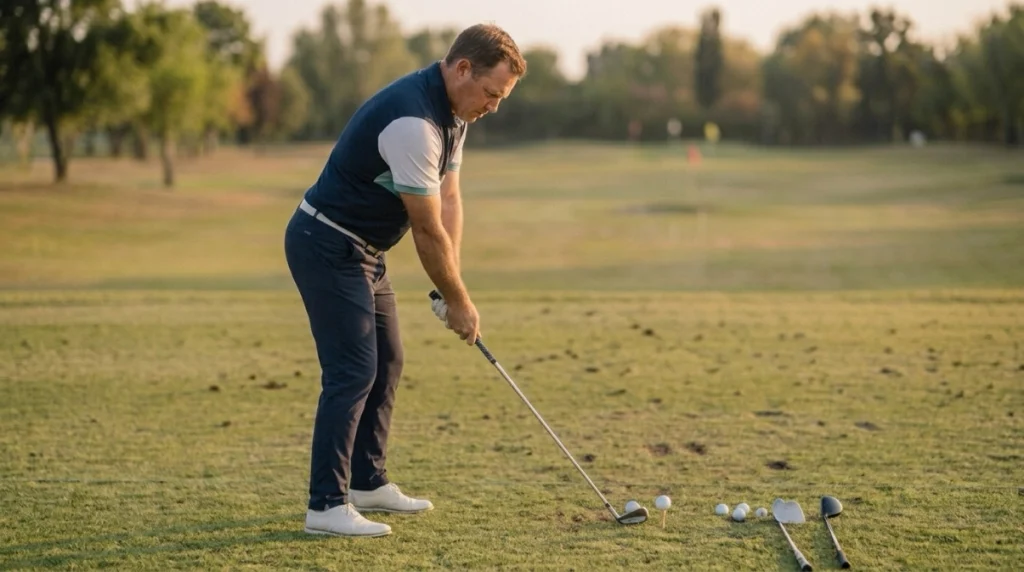
The basic idea stays the same, but the delivery changes with the club and shot. Ball position, loft, shaft length, desired trajectory, and low point all influence what the release looks like.
Do not try to make every club produce an identical impact position.
Driver release
The driver is longer and normally played farther forward than an iron. Many golfers also try to deliver it with a shallower or upward angle of attack.
- Avoid trying to create exaggerated forward shaft lean.
- Keep rotating rather than stopping to slap the clubhead at the ball.
- Let the longer club release around your body into a balanced finish.
- Check face angle before assuming a slice requires faster hand rotation.
Iron release
With a standard iron shot, the low point should occur on the target side of the ball. The golfer normally reaches impact with the handle somewhat ahead and then allows the club to release beyond contact.
- Pressure favors the lead side through impact.
- The chest and hips continue rotating.
- The lead wrist avoids a premature scoop.
- The arms extend as the club moves into the follow-through.
The collision between club and ball is extremely brief, which is another reason not to think about manipulating the clubface during contact. The USGA’s explanation of club-and-ball impact gives useful context on how quickly energy transfers during the strike.
Wedge and short-game release
Wedge release depends heavily on the shot. A basic chip may use much less wrist action than a longer pitch, bunker shot, or specialty shot.
- Basic chip: Favor a simple motion with predictable face control.
- Pitch shot: Allow enough wrist hinge and body rotation for the required length and trajectory.
- Flighted wedge: Use a controlled finish rather than trying to add a violent hand release.
- High soft shot: Technique changes significantly, so learn it separately instead of applying your full-swing release thought.
As of 2026, one of the most useful principles remains simple: match your release to the shot rather than chasing one universal hand position. Equipment and technique need to work together.
Section Takeaway: Driver, iron, and wedge releases share the same coordinated idea, but their impact conditions are not identical. Match the release to ball position, club design, trajectory, and intended shot.
FAQs About Release in Golf
What is the release in a golf swing?
The release is the coordinated unloading of the golf club as it moves through impact and into the follow-through. The wrists unhinge, the arms extend and rotate as needed, and the body keeps turning so the clubhead can move freely without a forced scoop.
Should I roll my wrists when releasing the golf club?
Your forearms naturally rotate during a full golf swing, but deliberately rolling the wrists as hard as possible is rarely a good universal instruction. Excessive hand rotation can close the clubface quickly and produce pulls or hooks. Focus first on grip, face control, and body rotation.
When should the wrists unhinge in the downswing?
The wrists begin unloading progressively during the downswing and continue through the hitting area. There is no exact release point that suits every golfer. Avoid dumping the wrist angles immediately from the top, but also avoid trying to hold them rigidly through impact.
What causes an early release in golf?
An early release, or casting, can come from a rushed transition, poor sequencing, excessive upper-body effort, or a compensation for another swing problem. The wrist angles disappear too soon, which can contribute to inconsistent low point, weak contact, and reduced clubhead speed.
How do I stop flipping my hands at impact?
Start with shorter swings and work on keeping your chest turning while the handle continues through the strike. Also check your grip and clubface position. If the face is too open late in the downswing, your hands may be flipping because they are trying to square it.
Is the driver release different from an iron release?
Yes, the delivery looks somewhat different. A driver is longer, has less loft, and is normally played farther forward. Irons usually involve more forward handle position and a low point beyond the ball, while driver delivery can use less shaft lean and a shallower attack.
Can my grip affect how I release the golf club?
Yes. Grip strength, pressure, and hand placement influence clubface orientation and wrist motion. A grip that makes the clubface difficult to control can force compensations during the release. Check your grip before making major changes to your downswing or follow-through.
Bottom line: Stop thinking of the release as a wrist snap you must perfectly time. Build a stable grip, sequence the downswing, keep rotating, and give your arms space to extend through the shot.
Start with slow half-swings and judge the change by contact, starting direction, and balance. If the same miss continues, a PGA Professional can help identify whether the real problem is your release, clubface, path, setup, or equipment.